
FREE COURSES
Free Online Courses with Certificates: What’s Actually Available and How to Start
A straight look at how free online learning works, which skills are worth your time, and what a certificate does for your CV.
Anúncios
You send applications and hear nothing back. Not because you can’t do the work, but because there’s nothing on your CV that proves it before someone reaches the experience section.
That gap is exactly what short online courses were built to close. Free, self-paced learning has gone from a nice-to-have to one of the quickest ways to put something on paper that an employer can actually check.
The catch is that not every free course is worth your time. Knowing which ones carry weight, what a certificate does and doesn’t do, and how to fit studying around a job is what separates finishing with something useful from abandoning halfway through. This guide covers all three.
Which Free Courses Are Worth Your Time?
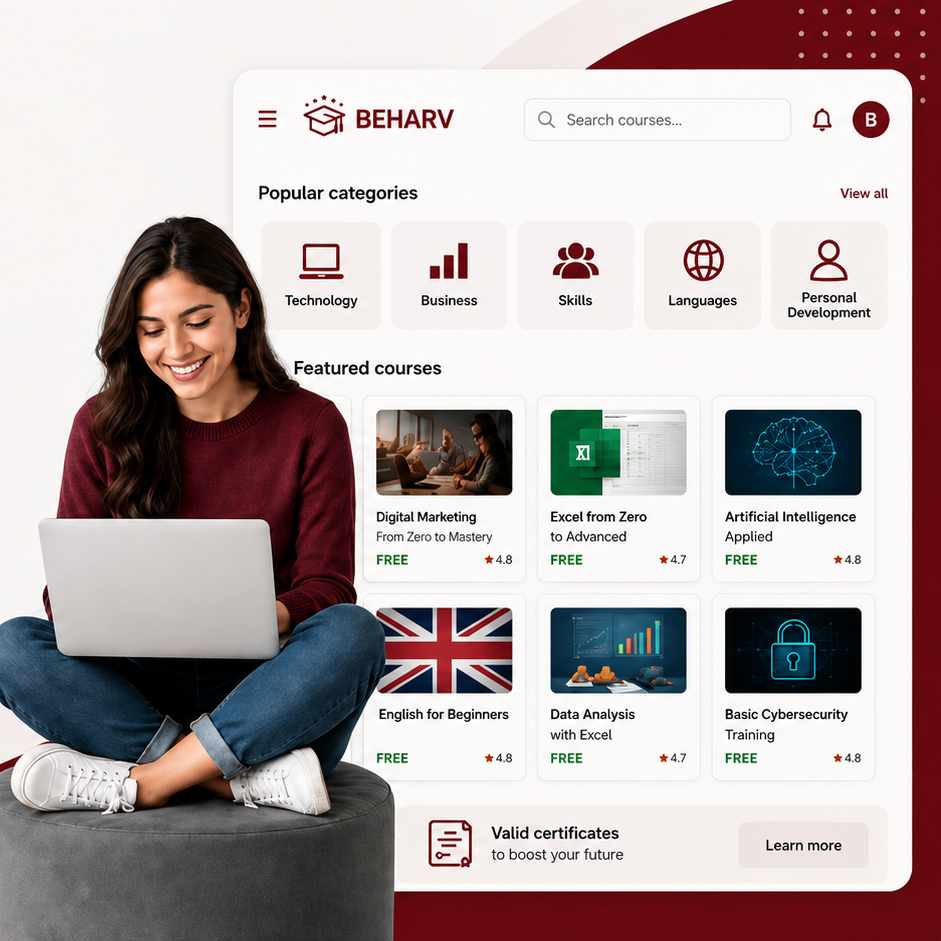
The catalogue on Beharv runs to more than 300 courses, but a handful of areas carry most of the hiring demand. These are the ones worth looking at first.
Computer and Digital Skills. Spreadsheets, data handling, office software and the digital tools that show up in almost every job advert now, whether or not the role is technical.
Why it matters: these are the skills most often listed as a requirement and most often missing from applications.
Sales and Customer Service. Communication, handling objections, service standards and closing techniques. Retail, call centres and service businesses hire for this all year round.
Why it matters: it’s one of the few fields where you can start without experience and move up quickly once you’re in.
Business and Admin. Basic bookkeeping, office administration, invoicing and general business operations, the backbone of small and medium businesses.
Why it matters: small businesses employ a large share of the workforce and this is the profile they hire most consistently.
Marketing and Social Media. Content, campaigns and managing a business presence online, including the side of it that lets you take on freelance work.
Why it matters: it’s one of the few skills you can start earning from before you’ve even finished learning it.
Health and Care. Care work, wellbeing and basic health support, an area where demand keeps climbing.
Why it matters: hiring in this sector is steady rather than seasonal, and training is often what gets you considered at all.
Languages and Communication. Workplace communication and language skills aimed at professional use rather than classroom theory.
Why it matters: it widens the range of roles you can apply for and strengthens your position when pay comes up.
Why Free Online Learning Works When Other Routes Don’t
There’s no queue and no deadline to miss. Learnerships and bursaries have application windows, limited places and processes that can take months. Plenty of people miss out simply because the window closed while they were busy. Online courses have no intake date. You start the day you decide to.
It removes the cost that stops most people. Studying usually costs more than tuition. It costs transport, time off work and materials. When the course is online and free, all of that disappears. The only thing you spend is your own time.
You don’t have to choose between earning and learning. Because the courses are self-paced, you study in the hours you actually have free, whether that’s early mornings, lunch breaks or after the kids are asleep. Nobody has to know you’re doing it until you’ve finished.
A certificate gives an employer something to verify. Experience you can’t prove is experience that doesn’t register in a screening process. A certificate turns what you know into something concrete that sits on the page next to your work history.
What Most People Get Wrong About Free Courses
First: free doesn’t mean low quality any more. The assumption that a free course must be a weaker course is out of date. Structured, well-built free courses exist precisely because platforms use them to reach people who would never enrol otherwise. What matters is whether the course has a clear structure and ends in something you can show, not what it costs.
Second: one certificate is fine, but a combination is better. The people who get the most out of this don’t stop at one course. Pairing two areas, like digital skills with customer service, or a language with business admin, builds a profile that’s much harder to skip past than a single certificate on its own.
Third: finishing is the hard part, not starting. Self-paced sounds easier than it is. Most people who drop out do so in the first two weeks, not because the content is difficult but because nothing in the week is holding the study time in place. Setting two or three fixed sessions a week is the single biggest predictor of finishing.
How to Sign Up, Step by Step
The whole process runs online and takes a few minutes. Most people who never get started simply stall at the first step, so it’s worth going in order.
- Decide what you want the course to do for you. Getting into a new field, strengthening the job you already have, or picking up something you can freelance with. The answer narrows the catalogue down fast.
- Browse the catalogue and open the course page. Check the description, the estimated hours and what you get at the end before you commit. Ten minutes of reading now saves you from twenty wasted hours later.
- Create your account. You need an email address you can access and nothing else. No documents to upload, no application to be approved.
- Enrol and open the first lesson the same day. Momentum matters more than planning here. People who open lesson one immediately are far more likely to finish than those who bookmark it for the weekend.
- Block out fixed study time in your week. Two or three set sessions, in slots you actually have free. Put them somewhere you’ll see them.
- Finish and download your certificate. Once the final module is complete, the certificate is available to download and can go onto your CV and LinkedIn profile that same day.
What You Need Before You Start
- An email address you can access.
- A phone, tablet or computer with an internet connection.
- A few hours a week you can realistically set aside.
- A rough idea of which field you want to move into.
- Somewhere to save your certificate once you’ve earned it.
What Happens After You Finish
When you complete the final module, your certificate becomes available to download. It confirms the course you completed and the skills covered, and it can go straight onto your CV, your LinkedIn profile and any application you’re busy with.
The bigger shift isn’t the document itself. It’s what it lets you do: apply for roles that were filtering you out before, walk into a performance conversation with something to point at, and keep stacking courses to build a profile that grows over time. People who keep learning tend to get more out of it than people who do one course and stop, because each certificate makes the next application stronger than the last.
You don’t need a deadline, an application or a cent to get going. The courses are open, the certificate is waiting and the only step left takes five minutes.